


A mutual fund fact sheet serves one purpose.
To help you comprehend the fund.
Paradoxically, at some points,
It appears that its only aim is to test your level of concentration.
One graph.
Five ratios.
Ten percentages.
Suddenly, you find yourself reading the same sentence for the third time.
Ironically, most of those numbers aren't vying for your attention.
Instead, each is trying to answer a question.
Where it puts its money.
Its past performance.
The level of risk involved.
The fees it charges.
And the management behind it.
The catch?
People have no idea what numbers matter most.
So either they read it all.
Or they avoid the factsheet altogether.
Neither helps.
Smartest investors do not work through the whole factsheet.
Nor do they fall asleep halfway between the graphs and ratios.
They avoid the clutter.
Pay attention to what is really useful to them.
When you know where to go,
The factsheet is no longer boring reading material.
But rather an easy route to making smarter investments.
Here,
We will see how to read mutual fund factsheet.
Start with the fund's objective
This is where you start.
Not with the returns.
Not with the graphs.
Start with the objectives.
Why?
Simple because here the fund reveals the objective.
Growth.
Stability.
Large-cap stocks.
Emerging players.
Each fund has its own objective.
And you can find all of these in this section.
This is how you should be reading it:
Not by asking, "Is this fund good?"
But by asking, "What does this fund aim to achieve?"
This simple change will completely alter your interpretation.
A fund that wants stability
Cannot be compared to a fund aiming for rapid growth.
These two funds are playing two different games.
Once you know what the objective is,
The whole factsheet will start to fall into place.
The performance becomes clearer.
The portfolio becomes clearer.
Even the risks become clearer.
An objective can be seen as a movie trailer before the actual film.
Neglecting this step makes everything else harder to understand.
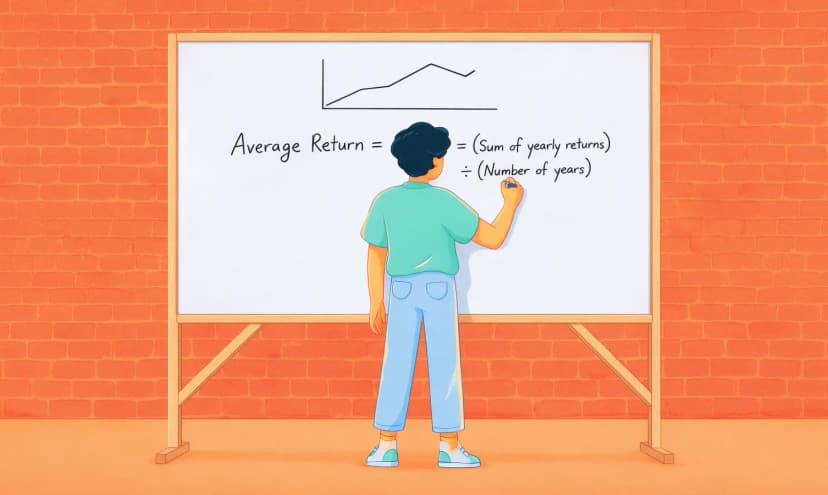
Returns are the headline, not the full story
Let’s face it:
This is the part everybody turns to first.
And that is completely fine.
Returns matter.
But to evaluate a fund by looking at just one performance figure
Is like evaluating a series from watching just one episode.
Rather than concentrating on the performance figures for a certain period,
Consider returns over various time frames.
One year.
Three years.
Five years.
Do not get distracted by the highest number.
One year is enough to make even an ordinary performer seem very good.
The trick lies in looking beyond.
See the returns of one year, two years, and five years at once.
This is where the trends become visible.
And trends are much more compelling than one-off performances.
Since even the best funds have a bad year.
What matters is being able to duplicate that success.
Don't search for the most impressive figure.
Search for stability.
Because the aim of investment is not to win one great year.
It is to endure many.
Behind the assets
Returns take centre stage.
The portfolio does all the heavy lifting
That's where you'll finally see who's really behind all of this.
The firms.
The industries.
The big plays.
The true engines of return.
Here’s the key.
Instead of just going through the holdings,
Focus on the top holdings.
Most likely, they’re carrying most of the weight.
Kind of like the cast list after enjoying an excellent film.
We all know the end.
But now you're discovering the people who brought that outcome to fruition.
Next, look at the sectors.
Is the fund concentrated in one sector?
Or does it cover multiple sectors?
All these provide you with much information
Regarding the positioning of the fund.
Because when you already know the composition of the portfolio,
The performance becomes predictable.
You know exactly what drives the returns.
Expense ratio: The small number with a big job
Every mutual fund has an associated cost.
Not a big one.
This is known as the expense ratio.
It's charged by the fund company to manage your money.
And most people skip over it far too easily.
Here’s how to interpret it.
Ignore the figure itself.
What’s important is its meaning.
Slightly high doesn’t mean bad.
And slightly low doesn’t necessarily imply good.
The key question is:
What are you receiving in return?
The best way to determine this is
Through comparison with similar funds.
Because, as far as investments go,
Small percentages tend to become larger as time passes by.
The expense ratio should be
Regarded as the subscription charge for your fund.
Do you pay for subscriptions that you don’t use?
Exactly.
Be aware of what you are paying.
Be aware of what you are receiving.
Then make a decision.
Meet the manager behind the wheel
Each fund has a fund manager.
Or even a group of fund managers.
Their job is to make investment decisions and manage the portfolio.
The factsheet will help you identify them and
The duration of their association with the fund.
This is not about spotting a star performer.
This is about consistency.
There is a strategy behind each fund's success.
It comes from someone's decisions.
And knowing that someone helps get a grip
On what goes on behind the numbers.
Risk metrics are not as scary as they look
This is when most people begin to lose interest.
Beta.
Standard deviation.
Sharpe ratio.
These terms may seem complex.
Their role is not.
And here’s the good news.
You don’t have to crack the code on every single word.
You aren’t earning finance merit badges.
You’re merely finding some context.
They will enable you to answer some very important questions.
What is the volatility of the mutual fund?
How risky is it?
Is the return on investment worthwhile for the risk taken?
You certainly do not have to become an instant financial expert.
There is only one thing you must remember:
Risk-free returns are only half the deal.
Asset selection reveals the fund's personality
While returns show what happened,
Asset allocation indicates how the fund performs.
This section highlights where the money of the fund is allocated.
Equities.
Bonds.
Cash.
Or possibly other classes of assets.
So why does it make a difference?
Two funds could perform similarly in terms of returns
But still be totally different
When it comes to the market performance.
Some funds will be steady.
Others might go through a roller coaster ride.
By knowing the asset allocation of the fund,
You can get some insight into how the ride would play out.
The AMC gives a clue
Each fact sheet lists AUM.
Short form for Assets Under Management.
In layman's terms,
It's the aggregate amount of money that investors have invested in the fund.
Think of it as an indicator of trust.
More AUM usually indicates that
A fund has garnered the confidence of more investors.
This does not mean that a small AUM means a less attractive investment opportunity.
However, AUM provides a dimension.
And investing is not only concerned with the asset management of the fund.
Understanding its scale of operations is also important.
Which is why AUM is no deal breaker.
It is just another piece of information.
And smart investors do consider such information.
The real trick: Don't read everything
This might come as a surprise.
The point is not
To analyse every inch of the factsheet.
The point is to uncover the signals from within the noise.
Take the objective first.
Examine the long-term record.
Go through the portfolio.
Check the costs.
Figure out the risks.
This should be sufficient to develop a judgment.
The next time you open a factsheet...
A fascinating thing starts to happen once you know where to look.
The figures no longer fight for your attention.
But begin working in its favour..
Now you begin to see what the story is about.
What it's all about.
How will it get done.
What are risks.
And how much it costs.
This is when factsheets turn into more than just paperwork..
It becomes a tool for making a decision.
Really, this was its purpose from the very beginning.
Not an instrument to test your financial knowledge.
But a tool
For better comprehension of your finances.