
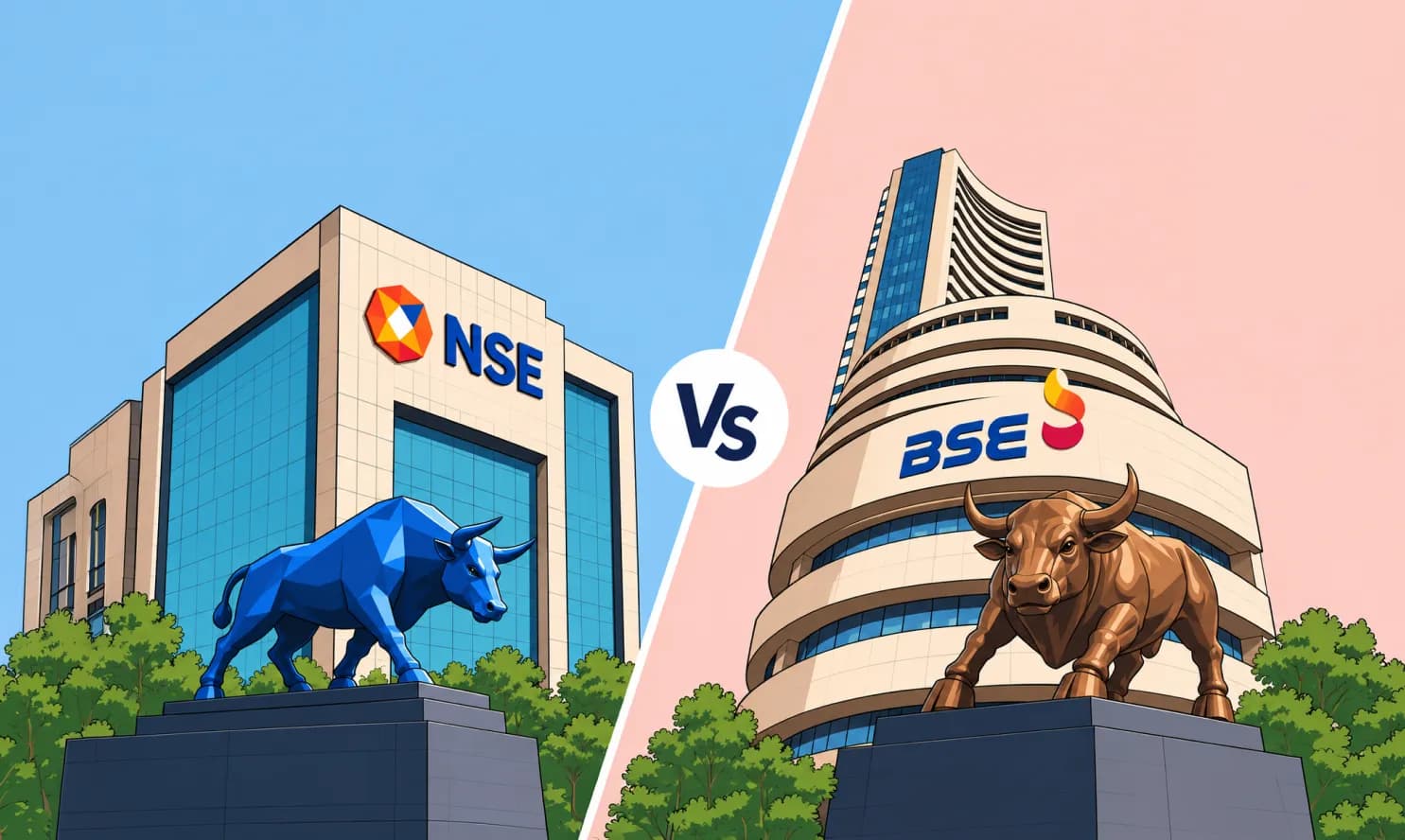


What is the Bombay Stock Exchange (BSE)?
BSE is old. Established in 1875. It’s actually the oldest stock exchange in Asia. It predates NSE by well over a century.
The benchmark index of the BSE is the Sensex, which tracks 30 of India’s largest and most established companies. BSE also hosts a massive number of listed companies. Nearly 6,000. This is because of the strong presence of BSE among SMEs and small-cap companies.
Historically, BSE is significant as it has been part of India’s financial journey for a long time before independence. It’s that legacy that shapes its identity today.
In terms of daily trading volume, BSE trails NSE. Still, BSE remains genuinely important, particularly for companies and investors eyeing the MSE and small-cap space.
What is the National Stock Exchange (NSE)?
NSE is relatively newer, launched in 1992. It started its operations in 1994. It’s the newer of the two big exchanges in India. But the “new” exchange came with an advantage. NSE built a fully electronic trading platform from the first day.
The Nifty 50 is the benchmark index of the NSE. It tracks the top 50 companies in terms of market capitalisation.
In terms of trading volume and liquidity, NSE dominates Indian markets. This means your orders are likely to get matched fast, and prices stay tight.
In derivatives trading, NSE continues to be the undisputed leader. In India, futures and options are traded here almost exclusively.
It’s this combination of speed, liquidity, and dominance in derivatives that results in the overwhelming participation of traders at the NSE.
The key differences between NSE and BSE
So, what’s the difference between NSE and BSE? Both of these are recognised stock exchanges in India, regulated by SEBI. They perform the same core job, connecting companies that raise money with investors willing to buy their shares.
Both NSE and BSE play a vital role in keeping the capital markets of India running.
But the same approach doesn’t necessarily mean they are identical. Each exchange has its own history, shaped over the decades.
The following table compares the two exchanges. Observe the differences between NSE and BSE side by side.
Most large-cap companies are listed on both the stock exchanges. This means you can trade the same stock on any of these exchanges. Investors often switch between NSE and BSE, depending on the exchange that offers liquidity, or where a specific stock gets listed.
Which exchange should investors choose?
Well, that depends entirely on what kind of investor you are.
Long-term investors
The exchange barely matters for long-term investors, as long as they find decent liquidity.
Your mutual fund returns come from the performance of the company over the years. The exchange executing your order has nothing to do with it.
Active traders
The scenario, however, is different for active traders. Liquidity matters when you trade in a shorter timeframe.
NSE usually offers tighter bid-ask spreads, faster order execution, and deeper markets. All these are critical when you enter or exit positions frequently.
This is the reason why NSE is popular for frequent, high-volume trading.
Can you buy the same stock on both exchanges?
Yes, that’s possible for dual-listed companies. Most large stocks come under this category.
Here's the reassuring part. Prices on NSE and BSE remain almost identical for the same stock.
Even if there’s a tiny gap, it gets closed almost instantly through arbitrage trading.
So, there’s no way to “choose a better price” by picking one exchange over the other. You can, however, choose one based on availability and liquidity for that specific stock.
Factors to consider before choosing an exchange
Before we wrap up, here’s a quick list of the factors you must consider before you choose a stock exchange for trading or investment.
- Liquidity of the stock on BSE and NSE
- Overall trading volume
- Brokerage charges
- Speed and quality of executing the order
- Whether the stock is actually available on both exchanges
- Whether you’re a long-term investor or an active trader
Conclusion
Ultimately, the difference between NSE and BSE comes down to scale, speed, and speciality. NSE leads on liquidity and derivatives. BSE carries its long history and a wider net of listed companies. Both the NSE and the BSE continue to be key financial pillars of the financial market in India.
As a trader, your priority should be to evaluate liquidity and the speed of execution. But if you’re exploring the market to invest for the long haul, spend less time picking an exchange and more time picking the right business. That decision matters far more to your returns.