


The formula
Here’s the simple mathematical formula used for this technique:
Number of years = 72 / Expected yearly rate of return
You only need one variable to arrive at the number, which is the expected rate of return per year. One of the best things about this formula is that it is super easy to use mentally, without even needing an Excel sheet or even a calculator app.
For instance, if you expect your mutual fund to earn 10% per year, you can simply divide 72 by 10. The result is 7.2 years. So, based on this expected return, your money may take around 7.2 years to double.
Similarly, if you expect a 6% return, it would take around 12 years to double your money.
The formula gives you a quick estimation without getting into complicated calculations. But remember that it is not an exact prediction. Mutual fund returns are market-linked and can change over time.
Practical ways of using the Rule of 72 in mutual funds
You can use the rule of 72 in two distinct ways. One is to estimate the time it may take to double your money. This is one of the most common ways to use this technique. The other way is to use it to find the rate of return needed to double your money in the desired time.
Let’s look at both use cases using different scenarios:
To calculate the time required to double your money:
If you shortlist a mutual fund that fits your financial goals and risk appetite, you can find out its average rate of return. Then, assuming the fund offers similar returns in the future, you can use this rule to estimate how long it will take to double your investment. However, it is important to note that the past returns may not necessarily reflect future returns.
For instance, you find a large-cap fund that offers an average yearly return of 9%. You want to know in how much time your lump sum investment of ₹50,000 can double. You simply divide 72 by 9 and quickly find the answer, which is 8 years.
To calculate the required rate of return to double your money:
Now, if you don’t know which fund to invest in, but you know that your financial goal is to have ₹1 lakh after 5 years. For that, you are willing to invest a lump sum of ₹50,000. In this case, the rule of 72 can be used to find what rate of return can help you reach your goal in 5 years.
You simply divide 72 by 5 and find out that 14.4% per year is the rate of return that can help you achieve your goal.
Limitations of Rule of 72 in mutual funds
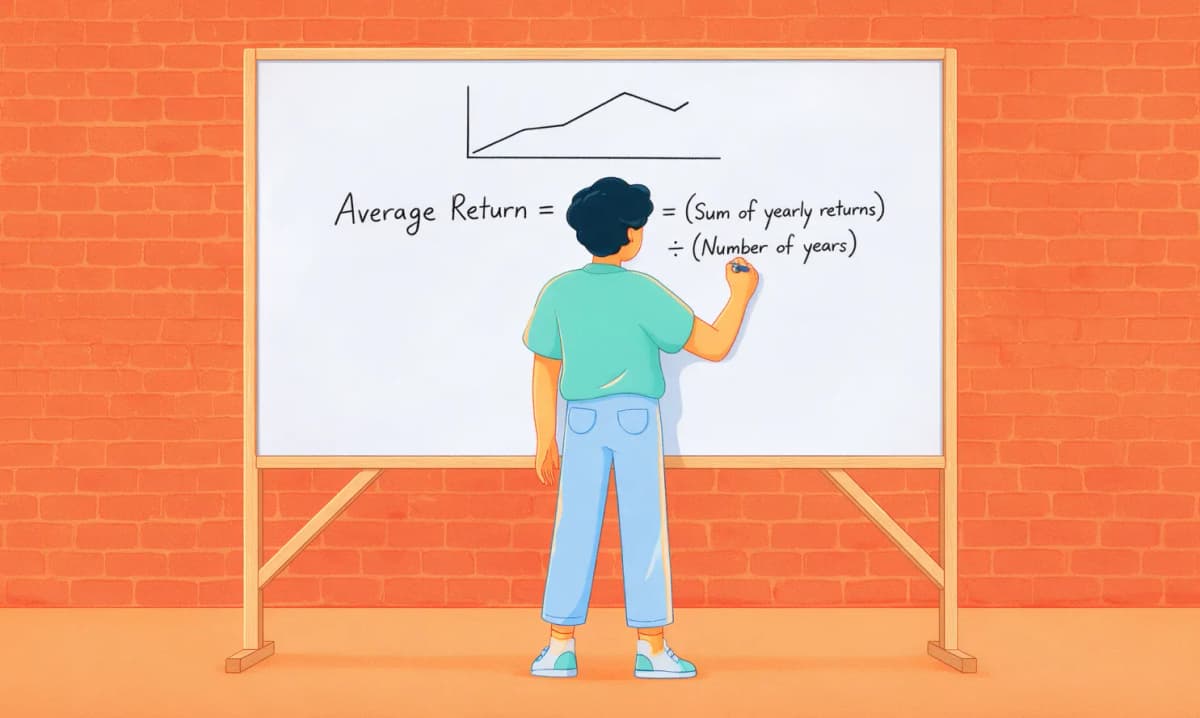
This rule is useful for getting a quick approximation, but you should not treat it as a guarantee. The biggest limitation is that it assumes your investment earns the same rate of return every year. This is rarely the case with mutual funds.
For instance, a mutual fund may give 15% in one year, 8% in another year and a negative return in the next year. The actual time taken for your money to double can therefore be different from what the rule of 72 suggests.
The rule also does not consider taxes, expenses or changes in your investment. These factors can affect the amount of money you actually receive.
Another important point is that the Rule of 72 works better when the expected return is reasonable and stays within a normal range. It becomes less accurate when you use very high or low return assumptions.
So, use the Rule of 72 as a simple estimation tool, not as a way to predict the exact future value of your mutual fund investment.
The bottom line
The rule of 72 in mutual fund investing can give you a quick idea of how long your money may take to double. But don’t use it to invest in funds just because they promise higher returns and you can multiply your money faster. Mutual funds are market-linked. So higher expectations come with higher risks.
Instead, you must focus on shortlisting schemes that match your financial goals and risk level. For stable wealth creation, you should rather start investing early and give your money enough time to grow. Wealth creation is a long-term process, and you don’t need to double your money overnight. Being consistent matters much more than trying to find the fastest way to grow your money.