


Why is Average Return important?
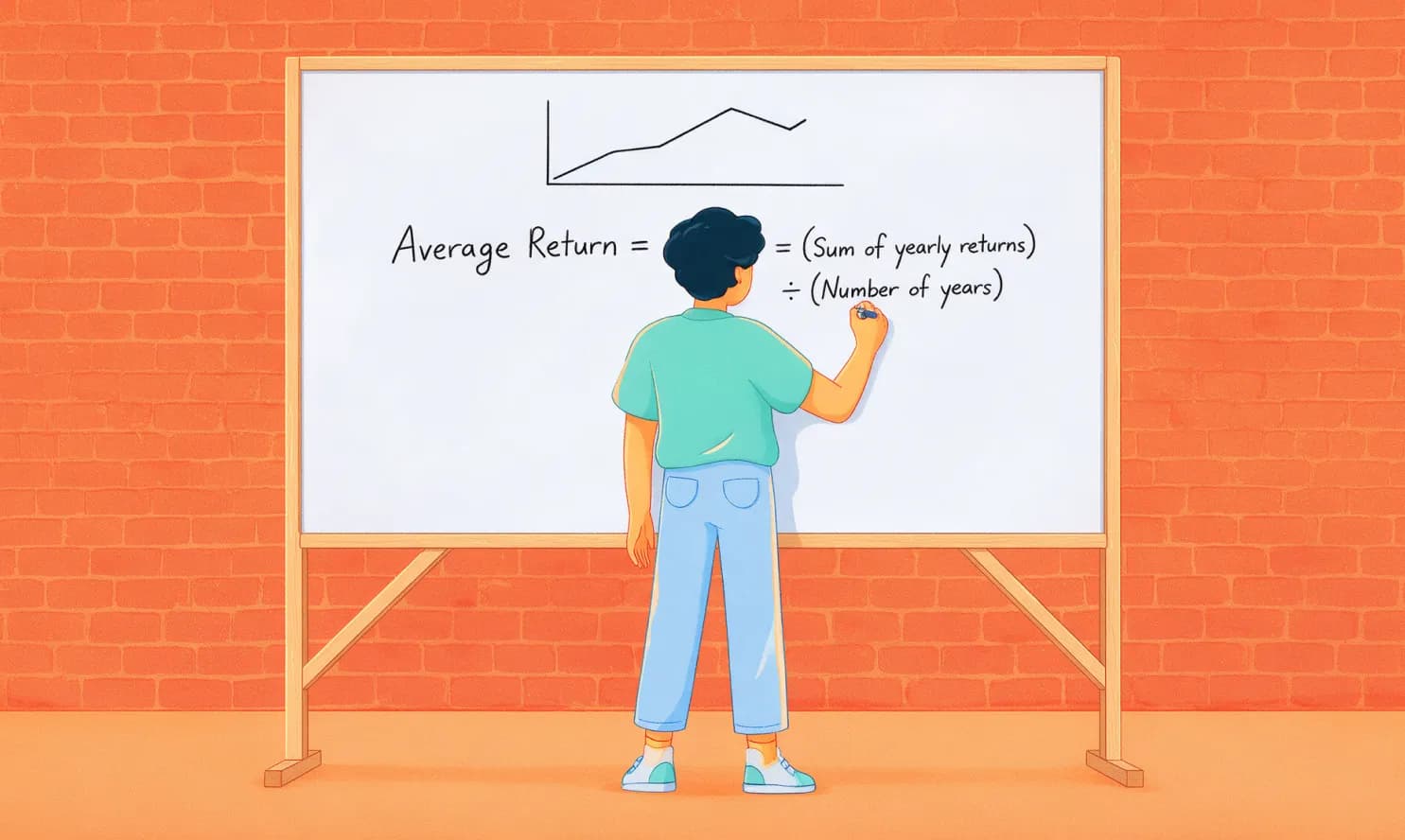
Average return in a mutual fund means how much return your mutual fund has given per year for the period you stayed invested. For instance, your mutual fund gives you a total return of 50% in 4 years. A simple average return would come to 12.5% per year.
But in reality, mutual funds don’t give the same return every year. One year, a fund may give you 20%. The next year, it may give 5%. It could even give a negative return in another year.
This is why a simple average fails to show true investment performance. So, what are different ways in which average return on mutual funds calculated?
Well, there are 4 types of returns on mutual funds:
- Absolute return
- CAGR
- XIRR
- Rolling returns
How is Average Return on mutual funds calculated?
How you calculate returns depends on your investment method and time horizon. Choose the method that fits your situation.
Absolute return:
You use this method if you stay invested for under a year. It simply tells you how much your investment has earned during the entire period. For instance, you invest ₹20,000 in a mutual fund, and after 6 months, it becomes ₹22,000. Then your profit is ₹2,000.
Your absolute return would be 10% [(₹22,000 - ₹20,000) / ₹20,000 x 100]
It does not convert the return into a yearly percentage. So, if you earned 10% in 6 months, it does not mean your yearly return automatically becomes 20%.
CAGR (Compound Annual Growth Rate):
It is a standard way to calculate yearly returns on one-time investments. CAGR tells you how much you earned on average on your investment by assuming that it grew at the same rate every year.
For instance, you invest ₹50,000 in a mutual fund, and after 4 years, it becomes ₹80,000. Your total return is 60%. But instead of simply dividing 60% by 4 years, CAGR considers the effect of compounding and shows you how much it grew every year.
In this case, the CAGR would be around 12.47% per year. CAGR works better than a simple average because it accounts for compounding growth.
XIRR (Extended Internal Rate of Return):
People often use this method for SIPs since you put money in on multiple dates. For instance, you may invest ₹2,000 every month in a mutual fund. People often use this method for SIPs since you put money in on multiple dates.
XIRR takes these different dates and amounts into account while computing your average return. If you have made any withdrawals, it also considers them in the computation. Because of this, it fits SIPs much better.
Rolling Returns:
You can track these average returns to check how a mutual fund scheme performed during different time frames. Instead of looking at one fixed period, it checks multiple periods. For instance, a 5-year rolling return looks at many different 5-year periods in the fund’s history.
This offers a broader view, showing you how the fund handled different market cycles. Rolling returns are available for 1-year, 3-year, and 5-year periods to help you analyse mutual funds before investing.
How much Average Return should you expect?
Mutual funds have no fixed average returns. Different mutual fund schemes invest in different types of assets and follow different strategies. Returns can also vary with market cycles.
For example:
- Equity schemes: Equity mutual funds invest in equity shares and offer higher returns for higher risk.
- Debt schemes: Debt funds invest in debt securities and offer more stable returns with limited risk and limited growth.
- Hybrid schemes: Hybrid funds invest in a mix of equity and debt. The risks and returns are better balanced.
- Index mutual funds: Index funds aim to track a particular index, so the average returns are stable with limited growth potential.
- Liquid funds: Liquid funds are very short-term schemes with low returns but high liquidity and lower risk.
Since all the different types of mutual fund schemes have different objectives, their average returns vary greatly. Even two equity schemes can offer different returns because they may invest in companies with different market caps or sectors.
What factors influence average mutual fund returns?
There are many factors that can have an impact on the average return you earn on a mutual fund investment, such as:
- Market conditions: Equity schemes can be affected by changes in stock market sentiment, while debt funds can be affected by changes in interest rates.
- Type of fund: Different categories of funds offer different levels of risk and returns. The performance of equity, debt, and hybrid funds can vary widely from one another during the same period.
- Investment period: Your returns can change depending on how long you stayed invested. Short-term market movements can have a bigger impact over shorter periods.
- Expenses: Mutual funds can take an expense ratio to cover management costs. These costs can reduce the average return you receive in your pocket.
The bottom line
While learning how the average return on mutual funds is calculated, it is important not to get distracted by the number. First, understand what average return actually tells you.
An absolute return looks at the overall profit or loss. CAGR and XIRR show the average return earned on your investment, while rolling returns help you analyse the scheme’s consistency. More than returns, starting early and staying consistent matters for making the most of mutual fund investing.