


How does compound interest work in mutual funds?
When you invest money in a mutual fund through a SIP or lump sum, here’s what actually happens:
- The fund manager of the scheme buys shares of companies.
- When those companies perform well and grow, their stock prices go up.
- They may also pay out portions of their profits as dividends.
- The fund reinvests income from capital appreciation and dividends, which raises the fund’s NAV.
- Next year, your returns are computed on that higher NAV.
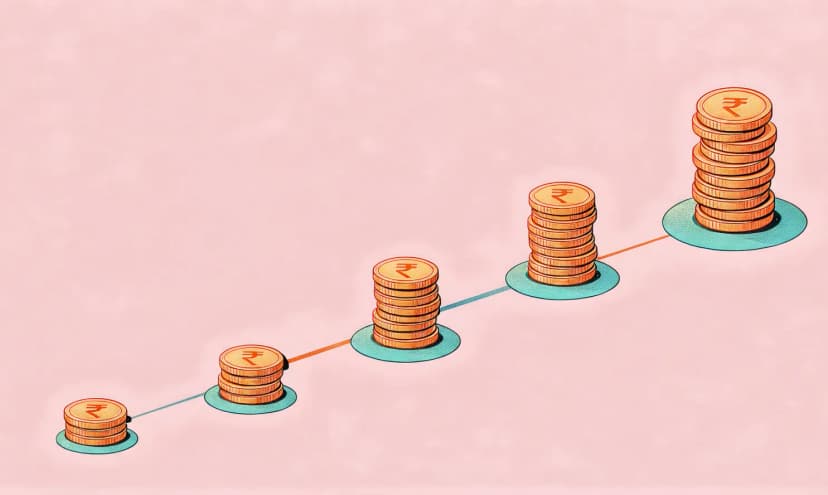
This is how compounding works in your mutual fund investments. Although you don’t actually reinvest the profits yourself, it works in the background if you have chosen the growth fund option. It works best when you give your investments more time to grow.
A simple example
Rohan and Aman are two college friends, and here’s their investment journey:
- Rohan starts investing early at the age of 20. He saves ₹2,000 every month from his pocket money and invests it in a SIP. He continues investing till the age of 30, after which he stops. In total, he invests ₹2.40 lakh (₹2,000 x 12 months x 10 years). He doesn’t touch the investment until he’s 50.
- Aman, on the other hand, spends all his pocket money and thinks that he will start investing when he has a good salary. So he begins investing ₹2,000 every month at the age of 30 and continues investing until he reaches the age of 50. His total investment amount is ₹4.80 lakh (₹2,000 x 12 months x 20 years).
Assuming they both invested in a fund which gave a similar return of 12% per year, who do you think has more money by the age of 50?
Here’s the interesting part. Despite Aman investing for 20 years and twice the money compared to Rohan, his investment value comes to around ₹20 lakh. On the other hand, Rohan’s investment stands strong at around ₹38 lakh.
Although compounding played a role in both cases, Rohan had a bigger advantage because he started early. This shows that compounding in mutual funds works better when your investment has more time to multiply.
Factors that affect your compounding
As we saw, starting early gives you an advantage in making the most of compounding. But at the same time, there are some factors that can break the effect of compounding, which you must avoid, such as:
Withdrawing money too often:
When you sell units of your mutual fund and withdraw money after seeing short-term gains, you interrupt the multiplication process. So, if you want to keep emergency money aside, start a separate scheme meant for shorter durations. Don’t withdraw from your wealth-building fund often.
Pausing your SIP instalments:
Many new investors make the mistake of pausing their SIP when market sentiment turns bearish. But in reality, it is a better time to invest. You see, when the market falls, the shares become cheaper, and so does the NAV of mutual funds. So the same SIP amount can buy more units. And when markets recover, these units can compound faster, as it brings down the average price of your total investment.
Opting for the dividend option instead of growth:
When you invest in a mutual fund, you can choose between growth and dividend. The dividend option (IDCW) is where gains like dividends are paid out to your bank account directly by the fund. The growth option is where gains are reinvested. Choosing the growth option helps with compounding your wealth faster.
The bottom line
Understanding how does compound interest work in mutual funds is necessary, but knowing how to use it is even more important. Compounding doesn’t make you rich in the short term. It needs time, regular investments and patience. You may not see a big difference in the first few years, but the effect becomes significant as your investment grows. Therefore, it is important to stay invested and be consistent to get the most out of your SIP investment.